Gregory of Nazianzus describes the incarnation of Christ as the marvelous union and paradoxical exchange. He deepens this further by describing the why of this great exchange, “He who is the giver of riches becomes a beggar. He begs for my flesh to enrich me with his divinity.” Christ has lowered himself, becoming the beggar, not in need of food or money but rather the beggar of souls. He has stepped into time to bring us the divine life, and he has done so through a glorious exchange.
I want to ponder for a bit on Christ becoming the beggar, who exchanged the riches of the divine life to bring us into his glory. This statement reminds me of Christ’s own teaching in Matthew 25:40, “Truly I tell you, whatever you did for one of the least of these brothers and sisters of mine, you did for me.” This passage of scripture was always on the back of my mind while I worked at a Rescue Mission.
I worked in Rescue Mission ministry for four years, first in Wyoming and then later in Greenville, SC. I remember my first day on the job. My task for the day was to get to know the residents, and one job I had was to do a roll call at lunchtime and monitor the dining room to hopefully avoid any altercations. I decided that I would sit down at one of the tables and get to know anyone who was there. I wanted to make this my daily practice. Little did I know how difficult that would be. Imagine the bus scene from Forrest Gump, where everyone suddenly has a friend saving the seat next to them. As I walked from table to table, people would tell me that their empty seats were taken or that someone else was coming. I realize now, several years down the road, that this was due to isolation and broken trust. It did get better in time. I remember thinking that I would just stand for the rest of lunch when I passed by the last table in the hall. Jesse looked at me and slid open a seat and said, “Why don’t you sit with us?” It was such a warm and disarming invite. I sat down and immediately realized my error. I had assumed that I would be welcomed at any table because of who I was. I thought I was doing them a service, but in reality it was I who needed humbling.
Jesse was my first friend who was a guest at the mission. He had come upon some extremely difficult times in those past few years. He had to shutter a business that he had started which he was quite proud of. He was a woodworker and could make exceptional furniture and art. In that first conversation he showed me pictures of his favorite pieces, and I could see the delight in his eyes. That day Jesse was Jesus to me. I came in with an attitude that I would be helping others, but that day I was the one who needed help. I needed someone to open a door for me—to help me be human, and to see those in the mission as people and not people to be saved. This dynamic changed everything for me. I was now solely interested in getting to know everyone for who they were, and many tables started to open up.
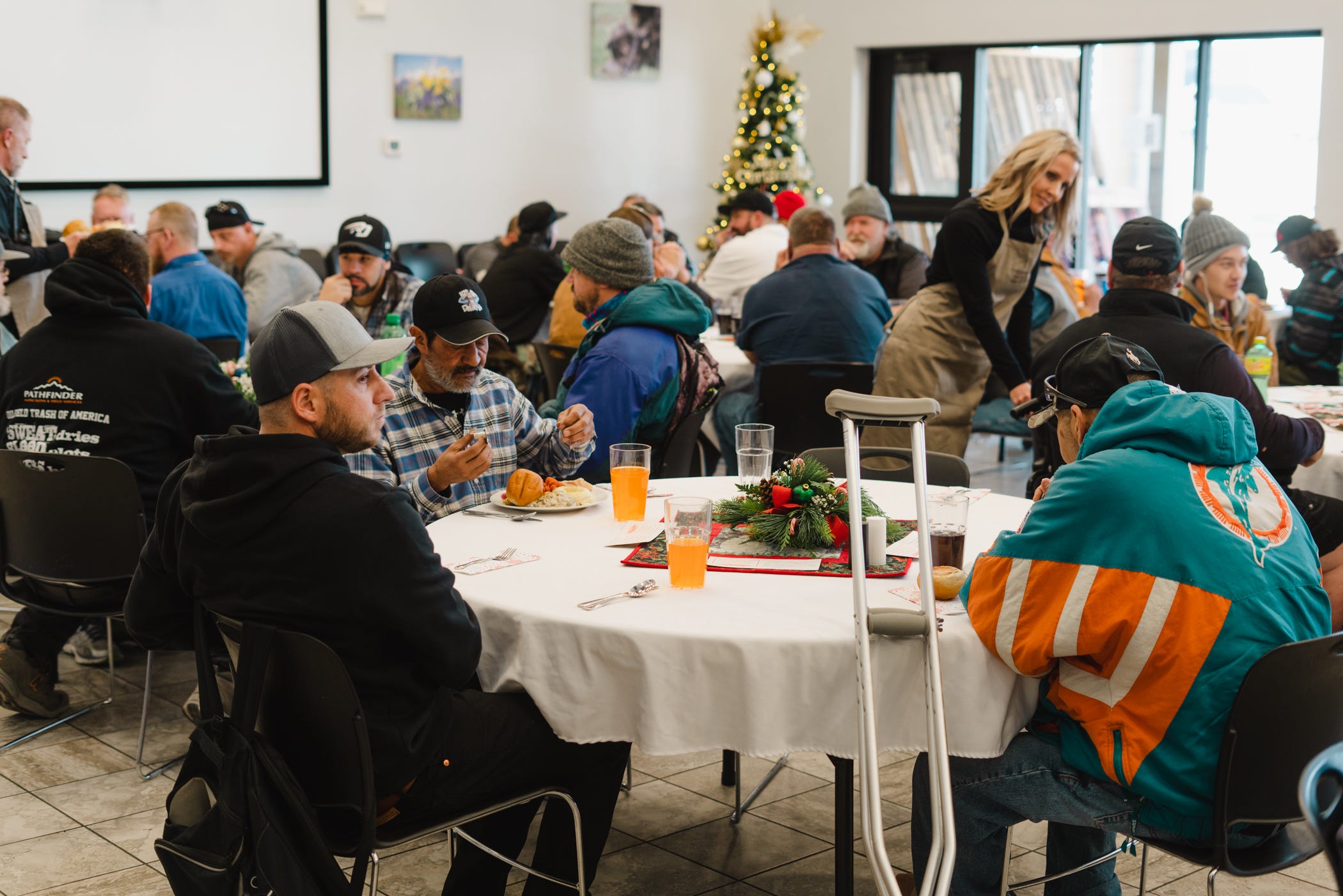
Back to Jesse. I’m not exactly sure what made him open up that day. Maybe he was an outsider as well. Or, maybe that day he bore a Christ-likeness that I needed to see. He lowered himself to call me to his table, just as Gregory’s beggar Christ lowered himself to call us to his. I can think of nothing more Christ-like than that.
Christ lowering himself is the example that we are called to imitate. For us that doesn’t have to look like a personal mission to save sinners; sometimes it’s simply sliding out a chair and inviting a hungry stranger to our table. At Jesse’s table I was the one in need, and he opened up a space for me and opened up his world. He shared his life, his dreams, his aspirations, and in that space I felt the very real presence of Jesus.
May our tables be set, and may there always be a seat available for the pilgrim, the stranger, the outcast, the backslider, and for Jesus himself. May we remember the sound of a chair sliding open and the simple invitation: “Why don’t you sit with us?” Amen.





 Pilgrim By The Sea